Sprint Race
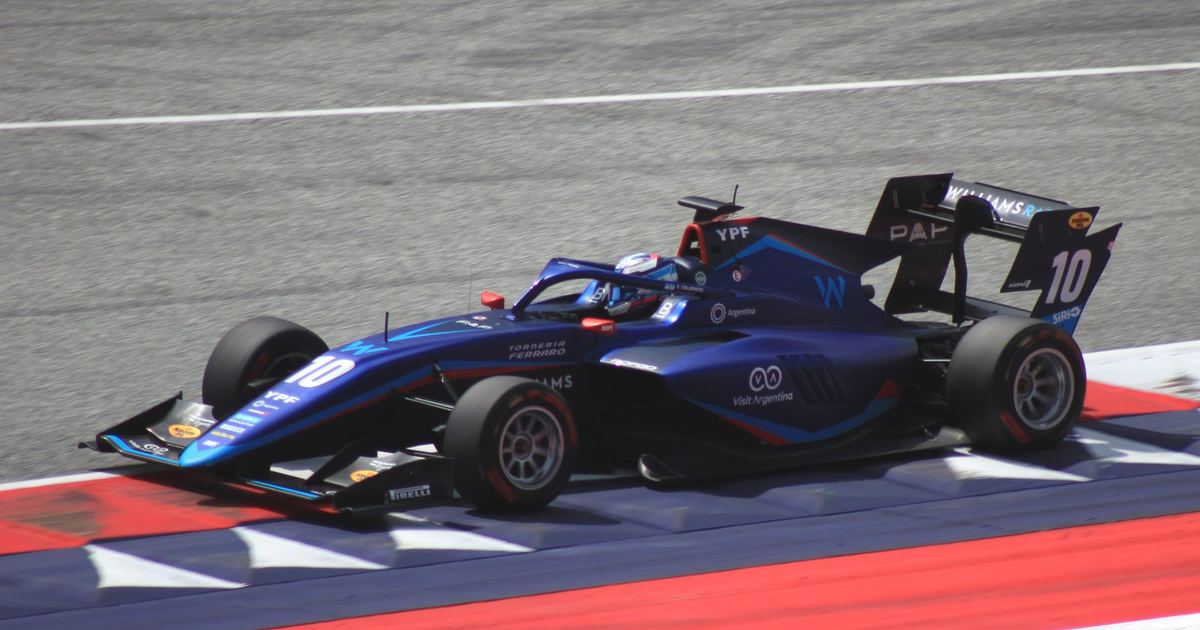
F2's Saturday race — 120km or 45 minutes, whichever comes first, with its starting grid set by reversing the top 10 finishers from Friday qualifying. Pays a maximum of 10 points to the winner.
Feature Race
F2's Sunday race — 170km or 60 minutes, whichever comes first, with its grid set directly by qualifying order. Pays 25 points to the winner, matching Formula 1's own scale exactly.
Reversed grid
The Sprint Race's starting order, set by taking the top 10 qualifiers and flipping them so 10th on the grid starts 1st and 1st on the grid starts 10th. Everyone outside the top 10 keeps their qualifying position.
Super Licence points
The FIA's points system that determines whether a driver is even eligible to hold an F1 race licence. F2's top 3 finishers in the final championship standings each receive 40 points on their own — the exact minimum required for an application.
Parc fermé
The FIA-controlled area cars are held in between qualifying and the race, during which teams are barred from most setup changes. F2 uses the same parc fermé principle as Formula 1 to stop late technical tweaks after grid positions are set.
DRS
The Drag Reduction System — a rear wing flap drivers can open in designated zones to reduce drag and boost overtaking, identical in principle to F1's own system and available in both the Sprint and Feature Race.
Dallara F2 2024
The spec chassis every F2 team runs — mechanically identical across the field, so races are decided by driver and team execution rather than car development budget.
Mecachrome V634T
F2's spec engine: a turbocharged 3.4-litre single-turbo V6 producing 620 horsepower, shared architecture with F3's less powerful, naturally aspirated version of the same unit.
Pole position
The grid's front spot for the Feature Race, awarded to Friday qualifying's fastest lap. It carries no such advantage for the Sprint Race, whose grid is set by the reversed-top-10 rule instead.
Format weekend
F2's collective term for the Friday qualifying plus Saturday Sprint Race plus Sunday Feature Race structure that repeats at every round of the season.
For the complete picture of how these terms fit together across a real race weekend, see our Formula 2 explained guide.
Frequently asked questions
What is the Sprint Race in F2?
F2's Saturday race, run over 120km or 45 minutes with its grid set by reversing the top 10 qualifiers. It pays a maximum of 10 points to the winner.
What is the Feature Race in F2?
F2's Sunday race, run over 170km or 60 minutes with its grid set directly by qualifying order. It pays 25 points to the winner — the same as an F1 race win.
What are Super Licence points and why do they matter in F2?
The FIA's eligibility system for holding an F1 race licence. F2's top 3 finishers in the final standings each get 40 points — the exact minimum needed to apply, achievable in a single season.
What engine does an F2 car use?
The Mecachrome V634T, a turbocharged 3.4-litre single-turbo V6 producing 620 horsepower — a step up from F3's naturally aspirated version of the same basic engine, and a step below F1's roughly 1,000hp hybrid units.
Sources

Pippa has followed open-wheel racing for 12 years, from Formula 1's turbo-hybrid era to IndyCar's short ovals, and has watched competitive sim racing grow from a niche hobby into a genuine motorsport discipline in its own right. She covers circuit and open-wheel racing, touring cars and esports for CNMOTOS.
View all articles by Pippa Cook →

.jpg)