Where the two disciplines actually overlap
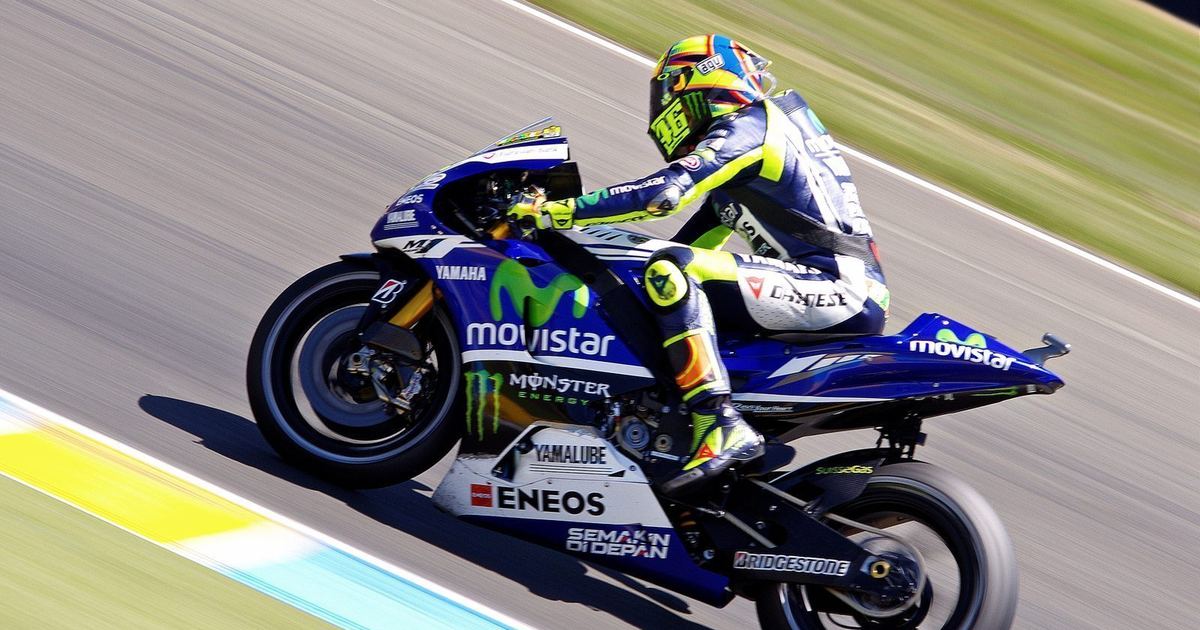
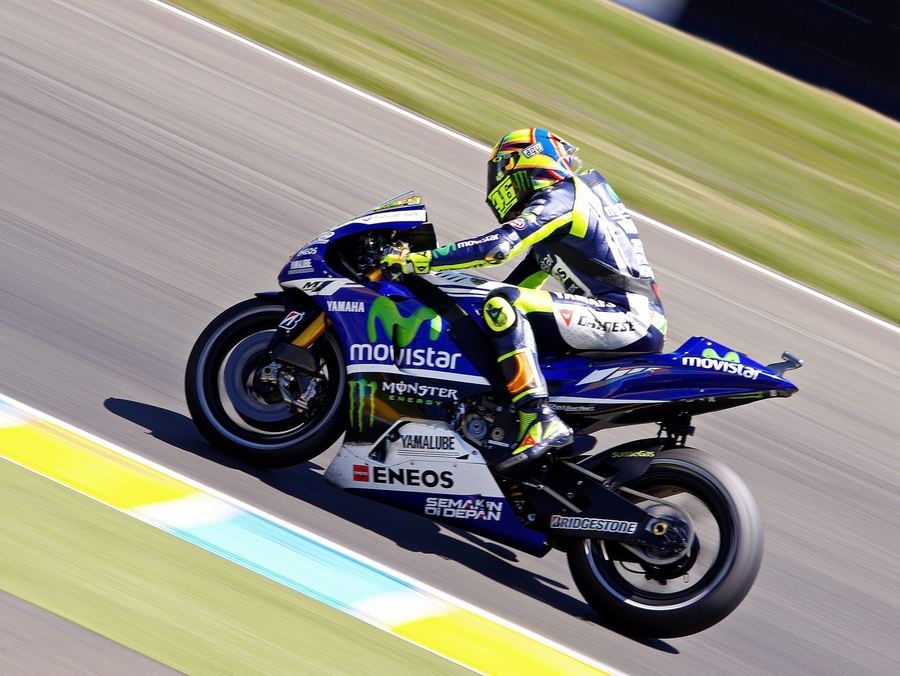
MotoGP and Formula 1 are both FIA or FIM-governed world championships built around a similar broad structure — a global calendar, a manufacturer-driven prototype vehicle, and a season-long points battle — but the actual demands they place on competitors and the technology involved diverge sharply beyond that surface-level similarity. See our complete guide to MotoGP and our complete guide to Formula 1 for each discipline's own fundamentals.
The physical demands: riding vs. driving
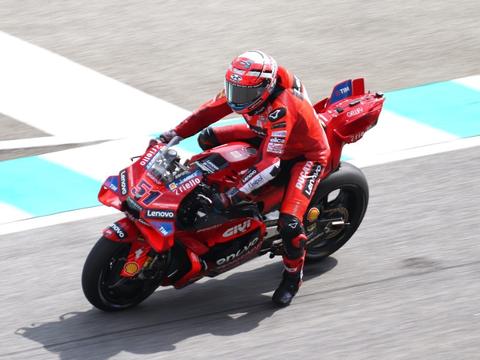
A MotoGP rider has to physically move their entire body weight across the bike to manage lean angle and load transfer through every single corner, a continuous full-body physical effort that has no direct equivalent in an F1 cockpit, where a driver's inputs are almost entirely hand and foot movements within a fixed seating position. F1 drivers instead endure enormous sustained neck and core loading from lateral cornering forces generated by aerodynamic downforce, a different but equally serious physical demand rooted in resisting g-force rather than actively moving the body to control the vehicle.
Both figures are real and verified: MotoGP riders regularly reach 60-65 degrees of lean angle from vertical through the fastest corners, while F1 drivers pull peak lateral loads around 5.6-6G in corners like Suzuka's 130R or Silverstone's Copse — see our full lean-angle explainer for exactly how riders achieve that.
Try it: same corner, two different units
Drag the slider below and watch both disciplines answer "how hard is this corner" in their own completely different unit — one leans a machine over, one crushes a driver sideways.
Same Corner, Two Completely Different Units
Drag the corner-speed slider and watch how each discipline actually measures "hard cornering" — a motorcycle leans further, a car's driver gets crushed sideways harder.
Verified peak: 60-65° from vertical in MotoGP's fastest corners.
Verified peak: ~5.6-6G in corners like Suzuka's 130R.
Which carries higher injury risk?
Motorcycle racing carries a meaningfully higher injury risk profile than modern Formula 1, since a MotoGP rider has no chassis or survival cell protecting their body in a crash, relying instead on suit technology, track surface design and rider skill to minimize harm. Formula 1's modern safety record, particularly since the introduction of the halo device, reflects decades of car-based crash structure development that a fundamentally open motorcycle simply cannot replicate in the same way.
The technology: chassis vs. engine focus
Formula 1 development effort concentrates heavily on aerodynamics and a hybrid power unit's energy recovery systems, while MotoGP development focuses more on chassis flex characteristics, tire interaction and a bike's overall power-to-weight balance, since motorcycles can't generate anywhere near the same aerodynamic downforce as an F1 car's dedicated wings and floor. That difference in technical emphasis reflects the fundamentally different physics of a two-wheeled vehicle that must lean to turn versus a four-wheeled car that turns while remaining upright.
Points systems and race formats compared
Both series award points to a fixed number of top finishers per race, but MotoGP has run a sprint race format on Saturday at every round since 2023, awarding a separate, smaller points allocation the day before the main Sunday race — a race-weekend structure Formula 1 has only partially adopted through a smaller number of standalone sprint weekends per season rather than every round.
How the cost of competing compares
Formula 1's cost cap and enormous car development budgets sit at a genuinely different financial scale than MotoGP, where manufacturer spending, while still substantial, doesn't approach F1's overall team expenditure, reflecting the fundamentally different technical complexity of a hybrid car power unit and full aerodynamic package versus a motorcycle engine and chassis. That cost difference is part of why MotoGP has historically supported a slightly larger number of independent, non-factory teams running production-based satellite machinery compared with F1's fully bespoke manufacturer-team model.
Calendar reach and global audience
Formula 1 has historically drawn a larger global television audience and broader mainstream commercial reach than MotoGP, though MotoGP maintains an extremely passionate, deeply knowledgeable fan base concentrated especially strongly in Italy, Spain and other parts of Europe where motorcycle racing culture runs particularly deep. Both series race on predominantly separate calendars with only occasional circuit overlap, reflecting largely distinct commercial promotion structures despite both falling under motorsport's broader global umbrella.
How fan culture differs between the two paddocks
MotoGP's paddock atmosphere is often described by fans and media as noticeably more accessible than Formula 1's, with riders historically more available for autographs, photos and direct fan interaction around circuits, partly reflecting a smaller overall commercial and security operation than F1's larger corporate hospitality footprint. That accessibility has helped MotoGP build an unusually close, personal connection between its stars and its fan base compared with the more insulated corporate presentation many associate with modern Formula 1.
Have riders and drivers crossed over?
Genuine top-level crossover between MotoGP and Formula 1 is essentially unheard of at the elite competitive level, since the physical skills — full-body lean management versus g-force-resistant seated driving — don't transfer in any meaningful direct way between the two disciplines. Some retired riders and drivers have occasionally tested cars or bikes from the other discipline in exhibition or promotional contexts, but those appearances have never translated into serious competitive crossover careers.
Frequently asked questions
Is MotoGP more physically demanding than Formula 1?
They demand different things — MotoGP requires continuous full-body movement to manage lean angle through every corner, while F1 demands sustained neck and core strength to resist lateral g-forces in a fixed seating position.
Is MotoGP more dangerous than Formula 1?
Generally yes — a MotoGP rider has no chassis or survival cell protecting their body in a crash, unlike a modern F1 car's extensive crash structures and halo device.
Does MotoGP have a sprint race format like F1?
MotoGP has run a Saturday sprint race at every round since 2023, while Formula 1 has only adopted a smaller number of standalone sprint weekends per season.
Which series has a bigger global audience, F1 or MotoGP?
Formula 1 has historically drawn a larger global television audience and broader mainstream commercial reach, though MotoGP has an extremely passionate fan base especially in Italy and Spain.
Have any riders successfully crossed over to Formula 1 or vice versa?
No genuine top-level crossover exists at the elite competitive level, since the physical skills involved don't transfer directly between riding a motorcycle and driving an F1 car.
Why does F1 focus more on aerodynamics than MotoGP?
A four-wheeled car can generate downforce through wings and floor design while remaining upright, while a motorcycle must lean to turn, limiting how much aerodynamic downforce it can practically use.
Is MotoGP cheaper to compete in than Formula 1?
Generally yes, MotoGP manufacturer spending doesn't approach F1's overall team budgets, reflecting the different technical complexity between a hybrid F1 car and a motorcycle engine and chassis.
What's the maximum lean angle a MotoGP rider actually reaches?
Around 60-65 degrees from vertical through the fastest corners — enough that a rider's knee, and often their elbow, make genuine contact with the track surface.
What's the maximum lateral g-force an F1 driver actually experiences?
Around 5.6-6G in the fastest real corners, such as Suzuka's 130R or Silverstone's Copse, sustained for several seconds at a time, dozens of times a lap.
Why can't F1's g-force and MotoGP's lean angle be directly compared?
They measure fundamentally different physical phenomena — lean angle describes how far a two-wheeled vehicle tilts to generate cornering force, while lateral g-force describes the sideways load a seated driver's body resists. Both are real measures of 'how hard is this corner,' just in unrelated units.
Do MotoGP and F1 share any technical regulations?
No meaningful overlap — they're governed by different bodies (FIM and FIA respectively) with entirely separate technical rulesets suited to two-wheeled and four-wheeled racing.
Which is more accessible for a new fan to start following, MotoGP or F1?
Both offer strong beginner entry points in different ways — F1's larger mainstream media presence makes it easier to stumble into, while MotoGP's more accessible paddock culture rewards fans who engage directly with the sport's community.
Sources

Jack has been a motorcycle racing enthusiast for as long as he can remember. For CNMOTOS, he covers everything from MotoGP and World Superbike to drag racing and the sport's more niche corners, like sidecar and three-wheel racing.
View all articles by Jack Korpela →

.jpg)
