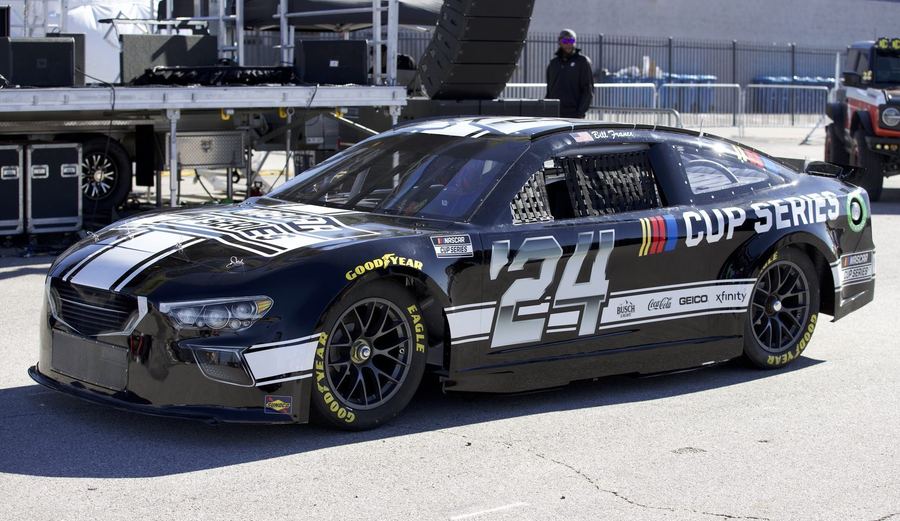
The cars: stock-bodied spec chassis vs. open-wheel hybrid
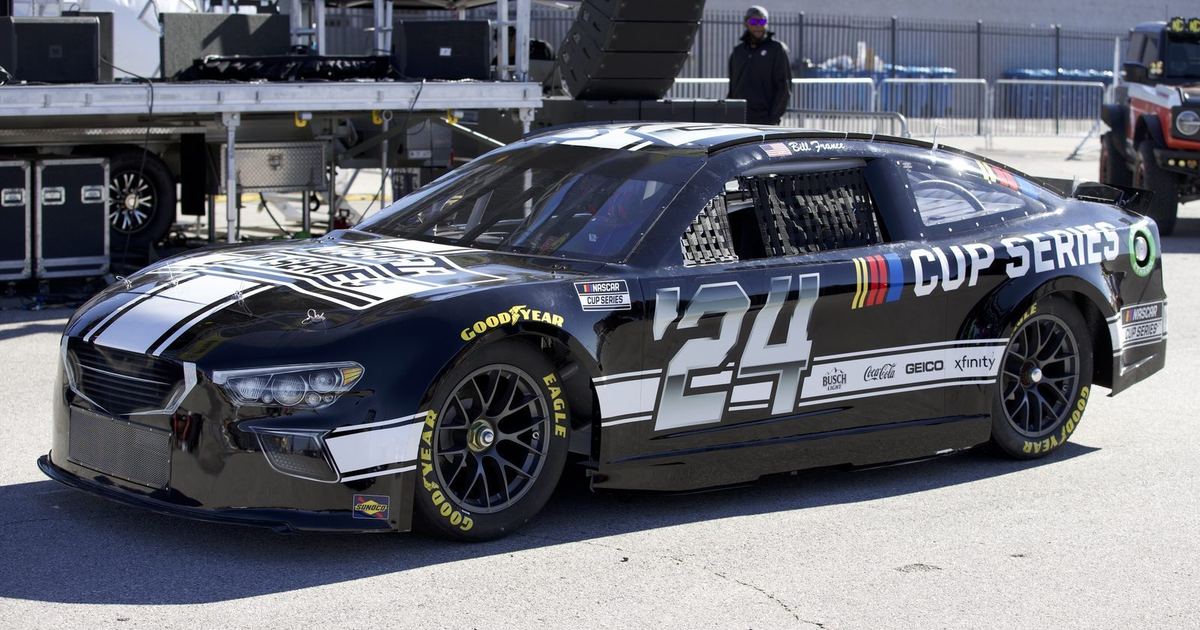
NASCAR's Next Gen Cup car and an IndyCar look almost nothing alike, and that's entirely deliberate — they're built to test different things. The Next Gen car runs a steel tube-frame chassis with an integral roll cage under a stock-car-styled body, powered by a naturally aspirated 5.86-liter V8 (Chevrolet's R07, Ford's FR9 or Toyota's TRD Phase-14, all built to near-identical output). Horsepower actually varies by track in 2026: 750hp on short ovals under 1.5 miles and road courses, but a reduced 510hp with a larger 7-inch rear spoiler at the superspeedways — Daytona, Talladega and a reconfigured Atlanta — specifically to keep the tighter, more survivable pack racing those tracks are built around.
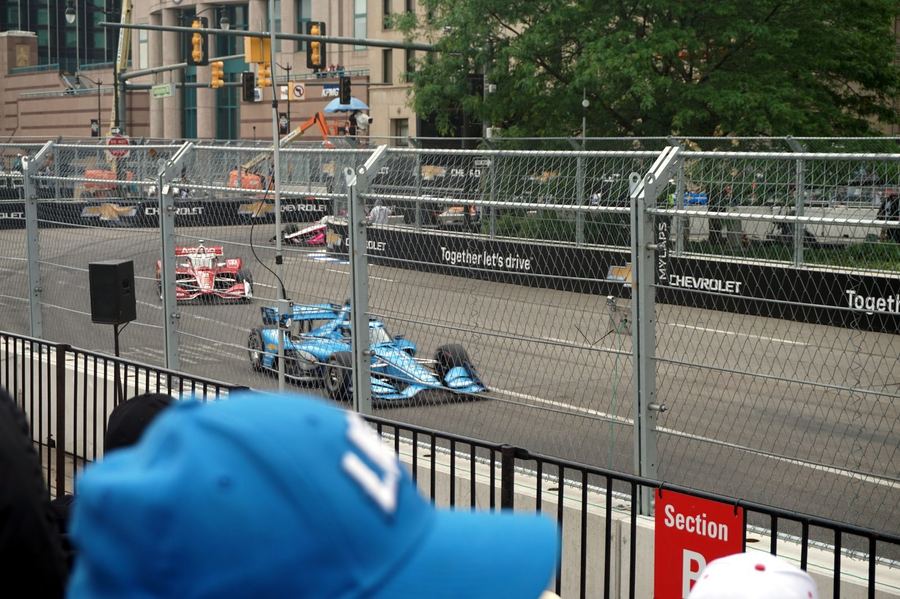
An IndyCar is a genuine open-wheel, open-cockpit machine built around a 2.2-liter twin-turbocharged V6 (supplied by Chevrolet or Honda) paired with a hybrid energy-recovery unit added in 2024. Base output runs roughly 575-650hp depending on boost, with the hybrid system adding up to another 60hp on demand — enough to push combined output past 700hp at Indianapolis, and beyond 800hp on road and street courses where push-to-pass boost stacks on top of the hybrid deployment.
One real similarity: both series run a single spec tire supplier rather than an open tire competition — NASCAR exclusively on Goodyear, IndyCar exclusively on Firestone — which keeps tire strategy about management rather than manufacturer choice in either series.
The calendar: oval-heavy vs. a genuine three-way mix
NASCAR's Cup Series schedule remains overwhelmingly oval-based, with only a handful of true road and street courses — Circuit of the Americas, Sonoma, Watkins Glen and the Chicago Street Course among them — mixed into a calendar still dominated by ovals of every size, from Bristol's short track up to Daytona and Talladega's superspeedways.
IndyCar's 2026 schedule runs 18 races split far more evenly: 6 ovals, 6 street courses, and the remainder on permanent road courses — a genuine three-way mix that demands a completely different kind of adaptability across a season than NASCAR's oval-heavy calendar does.
Try it: same finish, very different points
This is where the two series diverge in a way most casual fans never see spelled out with real numbers. Both award points by finishing position, but the shape of each table — and what happens to those points afterward — couldn't be more different.
Same Finish, Very Different Points
Drag the slider to a race finishing position and see what it's actually worth in each series' real 2026 points table.
Why NASCAR has a playoff and IndyCar doesn't
NASCAR's 2026 championship brought back the "Chase" format last used from 2004-2013: the top 16 drivers on points after a 26-race regular season advance into a 10-race playoff, with points reset and staggered based on regular-season standing, "win-and-you're-in" no longer guaranteeing an automatic playoff berth, and the title decided at a single winner-take-all finale at Homestead-Miami Speedway. A driver can lead the points table for 25 races and still lose the championship in one bad final weekend.
IndyCar runs no playoff or points reset of any kind. Every one of its 18 races counts equally toward one continuous season-long total, and the champion is simply whoever has accumulated the most points once the final race is complete — a format that rewards full-season consistency over a single hot week, the opposite trade-off NASCAR's Chase is deliberately built around.
Push-to-pass: IndyCar's strategic overtake button
IndyCar drivers get a genuinely unique tactical tool NASCAR has no equivalent for: push-to-pass, a driver-activated boost adding roughly 60 extra horsepower through increased turbo boost, deployable in limited total-second allotments across a race. Starting in 2026, push-to-pass became available continuously from the moment the green flag falls (rather than only after a set number of laps), turning it into a live strategic resource drivers must ration across an entire race rather than save for one late move.
NASCAR has nothing directly comparable — its overtaking tools are entirely aerodynamic and mechanical (drafting, tire wear, pit strategy) rather than a driver-controlled power button.
Drafting and pack racing on the ovals both share
Where the two series genuinely converge is superspeedway drafting. Both NASCAR (at Daytona and Talladega) and IndyCar (at Indianapolis and other high-speed ovals) rely on aerodynamic drafting to reach their highest straightaway speeds, producing the same tight, multi-car pack racing that makes those specific events look and feel more alike than almost anything else the two series do.
Drivers who've genuinely raced both
Crossover between the two series is rare but real, and not just a modern phenomenon. Tony Stewart remains the only driver in history to win a major open-wheel championship (the 1997 IndyCar/IRL title) and multiple NASCAR Cup Series championships (2002, 2005 and 2011) — proof the skillsets can transfer at the very highest level, even if very few drivers have ever managed it. Juan Pablo Montoya won the 2000 Indianapolis 500 and the 1999 CART championship before later racing NASCAR Cup full-time from 2007-2013.
More recently, Kyle Larson has twice attempted "The Double" — racing the Indianapolis 500 and NASCAR's Coca-Cola 600 on the same day, back-to-back, in both 2024 and 2025 — a modern reminder of just how physically and logistically demanding it is to compete competently in both series' completely different machinery within a single afternoon.
Which one should a new fan actually watch?
NASCAR rewards a new fan with drama built in by design — stage breaks, a 26-race regular season funneling into a win-or-go-home playoff, and pack racing at Daytona and Talladega that stays chaotic and unpredictable by construction. IndyCar rewards a fan who wants technical variety and a season-long story, with a genuine mix of ovals, street circuits and road courses and a championship that can't be reset by one late playoff format — every race actually matters, all year.
See our complete guide to NASCAR and complete guide to IndyCar for each series' full fundamentals.
Frequently asked questions
What's the main difference between NASCAR and IndyCar cars?
NASCAR's Next Gen car is a stock-bodied spec chassis with a naturally aspirated 5.86L V8 producing 510-750hp depending on track. An IndyCar is a true open-wheel, open-cockpit car with a 2.2L twin-turbo hybrid V6 producing 575-800+hp depending on hybrid and push-to-pass deployment.
Does IndyCar have a playoff like NASCAR?
No. IndyCar has no playoff or points reset — all 18 races in a season count equally toward one continuous total, and the champion is whoever has the most points after the final race. NASCAR resets points after 26 races for a 10-race 'Chase' playoff among the top 16 drivers.
What is push-to-pass in IndyCar?
A driver-activated overtake boost adding roughly 60 extra horsepower through increased turbo boost, available in limited allotments per race. Since 2026 it's available continuously from the green flag rather than only after a set number of laps.
How many points does a NASCAR race win give you in 2026?
55 points, a 20-point premium over the 35 points awarded for 2nd place — plus separate stage points (up to 20 more) and a possible fastest-lap bonus point, for a maximum of 76 points in one race.
How many points does an IndyCar race win give you in 2026?
50 points, a 10-point premium over the 40 points for 2nd place, plus up to 4 more from bonus points for pole position, leading a lap and leading the most laps.
Why did NASCAR bring back the 'Chase' playoff format in 2026?
NASCAR reintroduced the Chase format last used from 2004-2013: the top 16 drivers after a 26-race regular season advance into a 10-race playoff with points reset and staggered by regular-season standing, culminating in a single winner-take-all finale at Homestead-Miami Speedway.
Is NASCAR mostly oval racing and IndyCar mostly road racing?
NASCAR's calendar remains overwhelmingly oval-based with only a few road and street courses. IndyCar's 18-race 2026 schedule splits far more evenly across 6 ovals, 6 street courses and the remaining road courses.
Have any drivers raced both NASCAR and IndyCar at a high level?
Yes. Tony Stewart is the only driver ever to win both a major open-wheel title (1997 IndyCar/IRL) and multiple NASCAR Cup titles (2002, 2005, 2011). Juan Pablo Montoya won the 2000 Indy 500 and 1999 CART title before racing NASCAR Cup full-time from 2007-2013.
What is 'The Double' that Kyle Larson attempted?
Racing the Indianapolis 500 and NASCAR's Coca-Cola 600 on the same day, back-to-back — an extremely demanding feat Larson attempted in both 2024 and 2025.
Do NASCAR and IndyCar use the same tires?
No, but both use a single spec tire supplier rather than open competition — NASCAR exclusively runs Goodyear, IndyCar exclusively runs Firestone.
Which is faster, a NASCAR Cup car or an IndyCar?
It depends on the track — IndyCars are lighter and more aerodynamically efficient, typically reaching higher top speeds on road and street courses, while NASCAR's superspeedway pack racing at Daytona and Talladega produces some of the closest, highest-average-speed racing either series runs.
Why is a NASCAR win worth so much more than 2nd place compared to IndyCar?
NASCAR's 2026 table awards 55 points for a win against 35 for 2nd — a 20-point gap. IndyCar's table awards 50 for a win against 40 for 2nd — only a 10-point gap — reflecting NASCAR's greater emphasis on race wins specifically over pure points consistency.
Sources

Pippa has followed open-wheel racing for 12 years, from Formula 1's turbo-hybrid era to IndyCar's short ovals, and has watched competitive sim racing grow from a niche hobby into a genuine motorsport discipline in its own right. She covers circuit and open-wheel racing, touring cars and esports for CNMOTOS.
View all articles by Pippa Cook →