Staging
The process of a car rolling forward into the starting position, triggering a sequence of beams that activate the pre-stage and stage lights on the Christmas Tree, confirming the car is correctly positioned to begin a run.
Staging technique matters more than it might seem — some drivers deliberately stage shallow or deep within the beam to gain a slight reaction-time or rollout advantage, a subtle tactic experienced racers use deliberately.
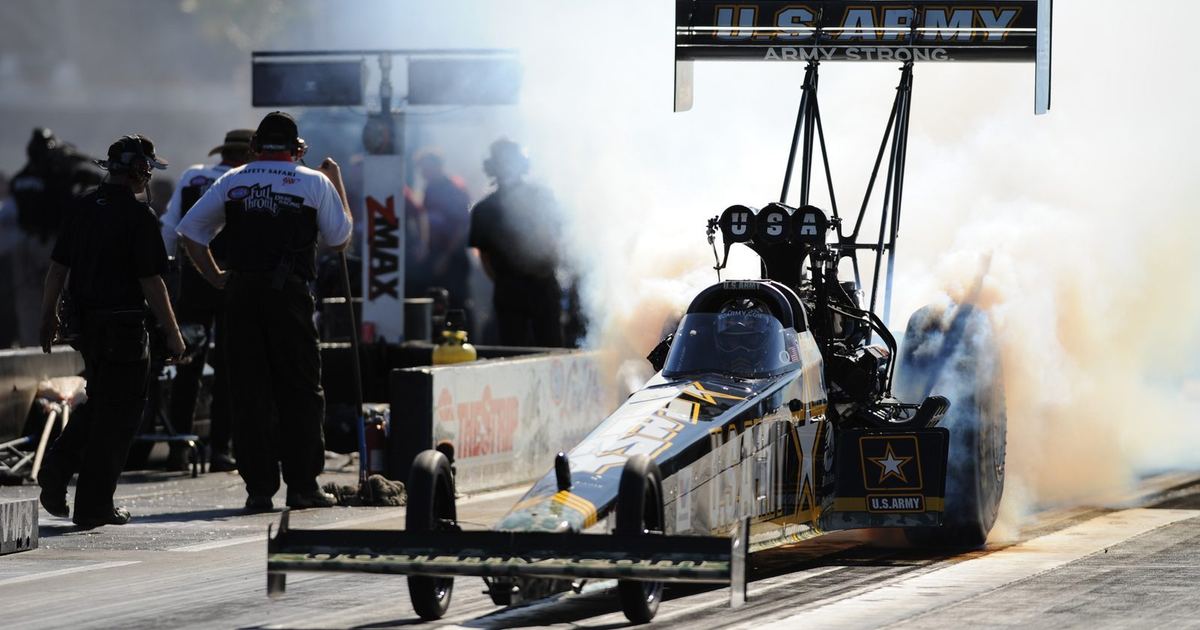
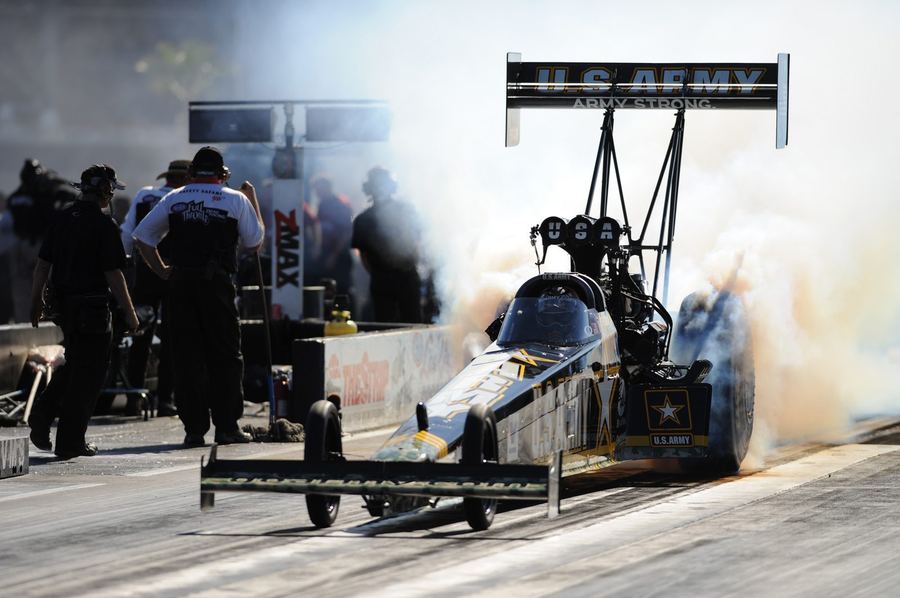
Burnout
A deliberate spinning of the rear tires before staging, done to heat the tire surface and clean off debris, improving grip for the actual run. It is a standard, expected part of a professional run rather than showmanship alone.
The burnout also serves a practical purpose beyond grip: it lets a driver and crew check that the car's drivetrain and tires are functioning correctly immediately before committing to a full-power launch.
Try the Christmas Tree yourself
This is the real light sequence, at real NHRA timing. Stage, watch the tree, and launch as close to green as you can — go too early and it's a red light, exactly as it would be on race day. Switch between the Pro Tree (all three ambers together, green 0.4 seconds later) and the Sportsman Tree (ambers 0.5 seconds apart) to feel how differently each one runs.
Try the Christmas Tree Yourself
Stage, then launch as close to green as you can without going before it. Pro Tree and Sportsman Tree run on genuinely different timing — try both.
Press "Stage" to roll into position, then watch for green.
Bracket Racing
A handicap racing format where a driver predicts their own elapsed time before a run and races to hit that prediction as closely as possible without exceeding it, making the format fair between cars of very different outright performance levels.
Read our full guide on trying drag racing for how bracket racing works as a realistic entry point for a beginner with an ordinary street car.
Elimination Ladder
The single-elimination bracket structure used in professional drag racing classes, typically seeded from qualifying results with the top qualifier facing the lowest-seeded qualifier in the first round.
Read our full explainer on the elimination ladder, including an interactive reaction-time duel, for exactly how seeding and progression through the bracket works.
Elapsed Time and Trap Speed
Elapsed time is the total time taken to complete a run from the starting line to the finish line, the primary measure used for qualifying position and handicap racing. Trap speed is the car's speed measured at the finish line, a separate figure reflecting outright performance at the end of the run.
Both figures are displayed after every run, and professional drag racing fans track both closely, since a car can post a strong elapsed time through a great reaction and still show a relatively modest trap speed, or vice versa.
Wheelie Bar
A support structure extending behind a dragster's rear wheels, preventing the front of the car from lifting too far under extreme acceleration, which would otherwise waste engine power lifting the car rather than driving it forward.
Wheelie bars are common on dedicated dragsters and heavily modified cars capable of enough acceleration to genuinely risk lifting the front wheels significantly off the ground at launch.
The full glossary, as flashcards
All eleven terms above, condensed — click to flip each card and test yourself.
Flip Through the Full Glossary
Click any card to flip it and reveal the definition.
Frequently asked questions
What is staging in drag racing?
The process of a car rolling forward into the starting position, triggering beams that activate the pre-stage and stage lights on the Christmas Tree, confirming correct position to begin a run.
Why do drag racers do a burnout before a run?
To heat the tire surface and clean off debris, improving grip for the actual run, and to let the driver and crew check the drivetrain and tires are functioning correctly before a full-power launch.
What is the difference between elapsed time and trap speed?
Elapsed time is the total time from the starting line to the finish line. Trap speed is the car's speed measured specifically at the finish line — two separate figures reflecting different aspects of a run.
What is a wheelie bar?
A support structure extending behind a dragster's rear wheels, preventing the front from lifting too far under extreme acceleration, which would otherwise waste power lifting the car instead of driving it forward.
What is bracket racing?
A handicap racing format where a driver predicts their own elapsed time and races to hit that prediction as closely as possible, making competition fair between cars of very different performance levels.
What is an elimination ladder?
The single-elimination bracket structure used in professional drag racing classes, typically seeded from qualifying results with the top qualifier facing the lowest-seeded qualifier first.
Why do some drivers stage differently than others?
Staging shallow or deep within the timing beams can give a slight reaction-time or rollout advantage, a subtle tactic some experienced racers use deliberately.
What is the difference between a Pro Tree and a Sportsman Tree?
A Pro Tree flashes all three amber lights simultaneously, with green following 0.4 seconds later. A Sportsman Tree flashes the three ambers 0.5 seconds apart in sequence, then green — a genuinely different rhythm to react to.
What counts as a red light in drag racing?
Leaving the starting line before the green light legally allows it — confirmed by the same staging beams used to set up the run. It's an instant, unconditional foul regardless of the rest of the run.
Why does NHRA use two different Christmas Tree timings?
The Pro Tree's tighter 0.4-second gap suits professional classes built around split-second reactions, while the Sportsman Tree's more forgiving 0.5-second sequential ambers suit a wider range of driver experience levels in non-pro classes.
What is a perfect reaction time?
As close to the green light as possible without going before it — human reaction time has a real physical floor, so an exceptional light is typically in the range of a few hundredths of a second after green.
Why is the Pro Tree harder to react to than the Sportsman Tree?
All three ambers fire at once with no lead-in rhythm, so there's nothing to anticipate — a Sportsman Tree's sequential ambers give the driver a beat to time their launch against instead.

Jack has been a motorcycle racing enthusiast for as long as he can remember. For CNMOTOS, he covers everything from MotoGP and World Superbike to drag racing and the sport's more niche corners, like sidecar and three-wheel racing.
View all articles by Jack Korpela →