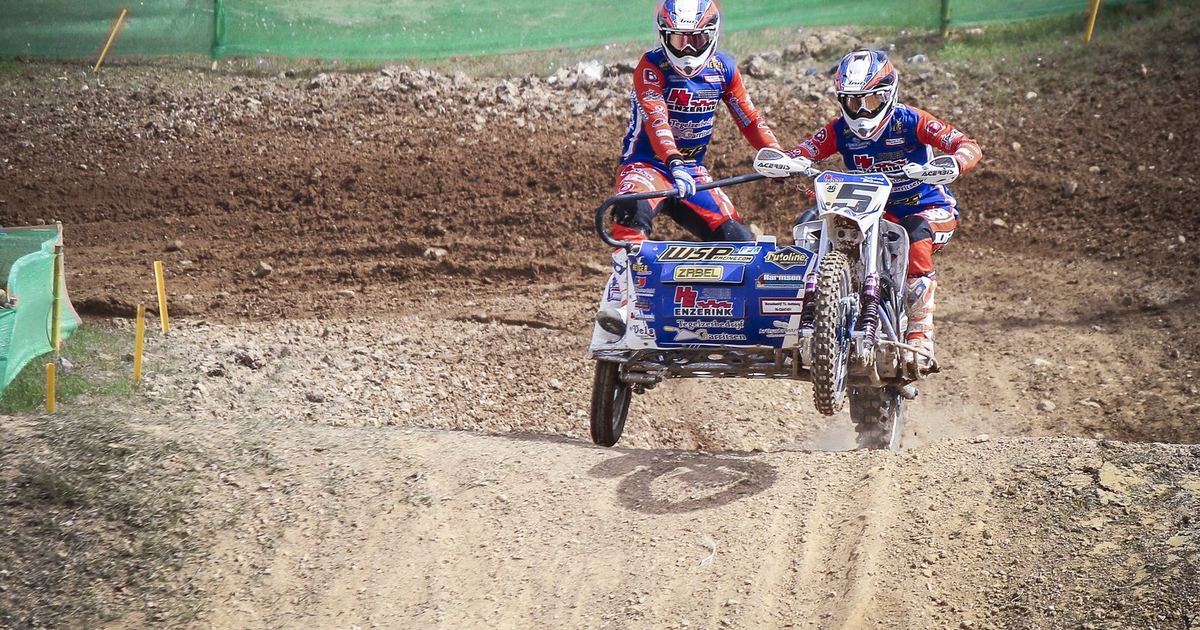
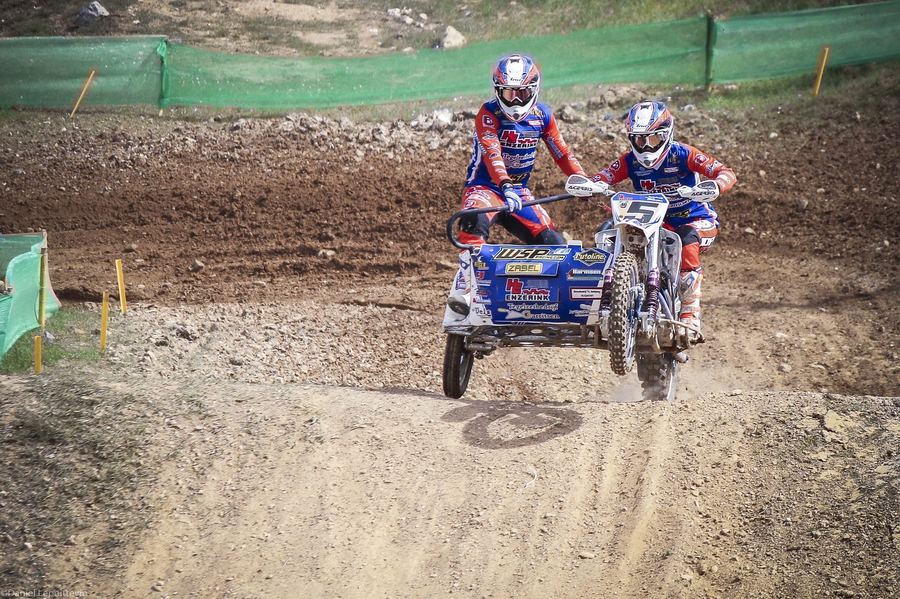
Outfit
The complete sidecar racing machine — motorcycle, sidecar chassis and passenger platform together — considered as a single competitive unit, distinct from a solo racing motorcycle which has no equivalent combined-unit terminology.
The term reflects how thoroughly the sidecar and platform are integrated into the racing machine, rather than being a simple attachment to an otherwise standard motorcycle.
Platform
The exposed area of a sidecar outfit where the passenger moves and positions themselves throughout a race, physically shifting weight to help balance the asymmetric machine through corners.
Platform design differs between sidecarcross and road-racing outfits, reflecting the different physical demands and terrain each discipline's passenger has to work with. See our lean-vs-weight-transfer interactive for exactly how a passenger's platform position changes with corner severity.
Sidecarcross vs Road-Racing Chassis
Sidecarcross outfits are built with suspension and ground clearance suited to rough, off-road terrain, resembling adapted motocross machinery. Road-racing outfits are built low and long, optimized for high-speed circuit cornering rather than absorbing off-road impacts — the low, reclined "kneeler" design is common in this branch.
These are genuinely different machines suited to their specific discipline, rather than the same chassis adapted lightly for different surfaces.
Weight Transfer
The core technique of sidecar racing: the passenger continuously shifting body weight around the platform to help balance and load the outfit correctly through corners, braking and acceleration, since the machine cannot lean the way a solo motorcycle does.
Weight transfer timing between driver and passenger, developed through extensive shared experience, is widely considered the single most important skill separating strong sidecar crews from average ones.
FIM World Championship Classes
The FIM organizes separate world championships covering sidecarcross and, in various forms, road-racing sidecar competition, each representing the top level of its respective branch of the discipline. Sidecarcross reached full world championship status in 1980, following a European competition that began in 1971.
Read our full explainer on sidecar racing scoring for how points and championships actually work within each format.
Crew
The standard term for a sidecar racing pairing — driver and passenger together — reflecting that both are credited jointly for a result rather than one being scored as a supporting role to the other.
Results and coverage in sidecar racing typically refer to a named crew rather than a single driver's name, distinguishing it from most solo motorsport reporting conventions.
The full glossary, as flashcards
All eight terms above, condensed — click to flip each card and test yourself.
Flip Through the Full Glossary
Click any card to flip it and reveal the definition.
Frequently asked questions
What is an outfit in sidecar racing?
The complete sidecar racing machine — motorcycle, sidecar chassis and passenger platform together — considered a single competitive unit rather than a motorcycle with an attachment.
What does platform mean in sidecar racing?
The exposed area of a sidecar outfit where the passenger moves and positions themselves throughout a race, physically shifting weight to help balance the machine.
What is weight transfer in sidecar racing?
The core technique of the sport: the passenger continuously shifting body weight to help balance and load the outfit correctly through corners, since it cannot lean the way a solo motorcycle does.
How do sidecarcross and road-racing chassis differ?
Sidecarcross outfits have suspension and ground clearance suited to rough off-road terrain, resembling adapted motocross machinery, while road-racing outfits are built low and long for high-speed circuit cornering.
Why is a sidecar racing pairing called a crew?
Because both driver and passenger are credited jointly for a result, reflecting that neither is scored as a supporting role to the other — a distinct convention from most solo motorsport reporting.
Does the FIM run sidecar racing world championships?
Yes, separate world championships for sidecarcross and, in various forms, road-racing sidecar competition, each representing the top level of its respective branch.
What is the most important skill in sidecar racing?
Weight transfer timing between driver and passenger, developed through extensive shared experience, widely considered the single biggest differentiator between strong and average crews.
What is a kneeler sidecar?
A low, aerodynamic road-racing sidecar design that seats the driver in a reclined position, common at high-speed venues like the Isle of Man TT.
When did sidecarcross become a world championship?
1980, following a European competition that began in 1971 as the FIM Cup and became the FIM European Championship in 1975.
Is a sidecarcross outfit the same machine as a road-racing sidecar?
No — despite sharing the basic driver-plus-passenger sidecar concept, they're built to genuinely different specifications suited to off-road versus high-speed paved-circuit racing.
Who governs sidecar racing internationally?
The FIM (Fédération Internationale de Motocyclisme), the same body that governs solo motorcycle Grand Prix racing, running sidecarcross and road-racing sidecar competition as separate world championships.
Why does platform design differ between sidecarcross and road-racing outfits?
Because the physical demands differ — sidecarcross passengers need grip and mobility for off-road jumps and ruts, while road-racing passengers need an aerodynamic, low position for sustained high-speed cornering.

Jack has been a motorcycle racing enthusiast for as long as he can remember. For CNMOTOS, he covers everything from MotoGP and World Superbike to drag racing and the sport's more niche corners, like sidecar and three-wheel racing.
View all articles by Jack Korpela →

.jpeg)