Chassis Flex
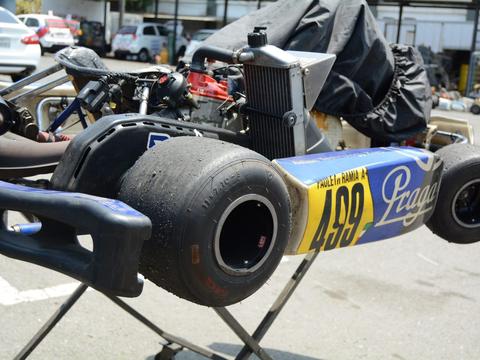
Since a competition kart has no suspension, the chassis itself must flex to allow the inside rear wheel to lift slightly through a corner, since karts also lack a differential. Seat position, chassis stiffness settings and tire pressure all directly affect how much a chassis flexes.
Understanding chassis flex explains why karting setup, despite the machine's apparent simplicity, is genuinely technical — small adjustments to stiffness and geometry meaningfully change how the kart handles.
No Differential
Competition karts have no differential, meaning both rear wheels are rigidly connected and must rotate at the same speed even through a corner, where the inside wheel would naturally want to travel a shorter distance than the outside wheel.
This is precisely why chassis flex matters so much — without a differential to handle that speed difference, the chassis must physically twist to let the inside rear wheel lift and effectively disengage from the ground briefly.
Sprint Karting vs Endurance Karting
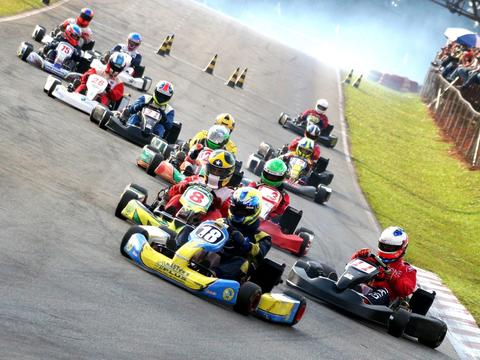
Sprint karting involves short, intense individual races, typically the format most competitive karters are familiar with. Endurance karting instead runs longer races, sometimes with driver changes similar in spirit to endurance car racing, testing reliability and sustained pace rather than pure sprint speed.
Both formats use broadly similar equipment principles but reward somewhat different skills — sprint karting rewards outright single-lap pace and starts, while endurance karting rewards consistency, tire management and pit strategy.
Arrive-and-Drive
A simplified, cost-controlled karting class or event format where much of the mechanical preparation and equipment provision is handled by the organizer rather than the competitor, reducing both the cost and the technical knowledge required to compete.
Arrive-and-drive formats exist at both junior and senior levels specifically to make competitive karting more financially accessible without eliminating genuine racing.
TaG Engine
Touch-and-Go, referring to an engine that starts with an onboard electric starter rather than requiring the kart to be push-started, a genuine convenience feature used across several junior and entry-level classes.
TaG engines are typically two-stroke, water-cooled units and are common in classes like OK-Junior, distinguishing them from older push-start-only engine designs still used in some categories.
Class Names Quick Reference
OK-Junior and OK cover the direct-drive junior and senior classes respectively, while KZ and KZ2 cover the gearbox classes. Simplified variants of the junior and senior direct-drive classes exist specifically to reduce cost.
Read our full explainer on karting classes for exactly what each one involves and how a driver progresses between them.
Frequently asked questions
Why do karts need no suspension?
The chassis itself is designed to flex enough to allow the inside rear wheel to lift slightly through a corner, replacing the function a suspension system and differential would otherwise provide.
Why don't karts have a differential?
Karting deliberately omits a differential; instead, chassis flex allows the inside rear wheel to briefly lift and effectively disengage from the ground through a corner, handling the speed difference between wheels that a differential would normally manage.
What is the difference between sprint and endurance karting?
Sprint karting involves short, intense individual races rewarding outright pace and starts. Endurance karting runs longer races, sometimes with driver changes, rewarding consistency, tire management and strategy instead.
What does arrive-and-drive mean in karting?
A simplified, cost-controlled format where much of the mechanical preparation and equipment provision is handled by the organizer, reducing both cost and required technical knowledge for competitors.
What is a TaG engine?
Touch-and-Go, referring to an engine with an onboard electric starter rather than requiring a push start, a common feature in junior and entry-level karting classes.
Why does chassis stiffness matter in karting?
Because the chassis itself substitutes for both a suspension system and a differential, small adjustments to stiffness, seat position and tire pressure meaningfully change how the kart handles through corners.
Are arrive-and-drive classes less competitive than standard classes?
No, they still offer genuine competitive racing — the simplification is in cost and mechanical preparation requirements, not in the seriousness or competitiveness of the racing itself.

Maya grew up watching rally stages and motocross before following both sports closely as an adult, and covers the off-road side of motorsport for CNMOTOS — from World Rally Championship gravel stages to Supercross stadiums and grassroots karting.
View all articles by Maya Torres →