The core difference
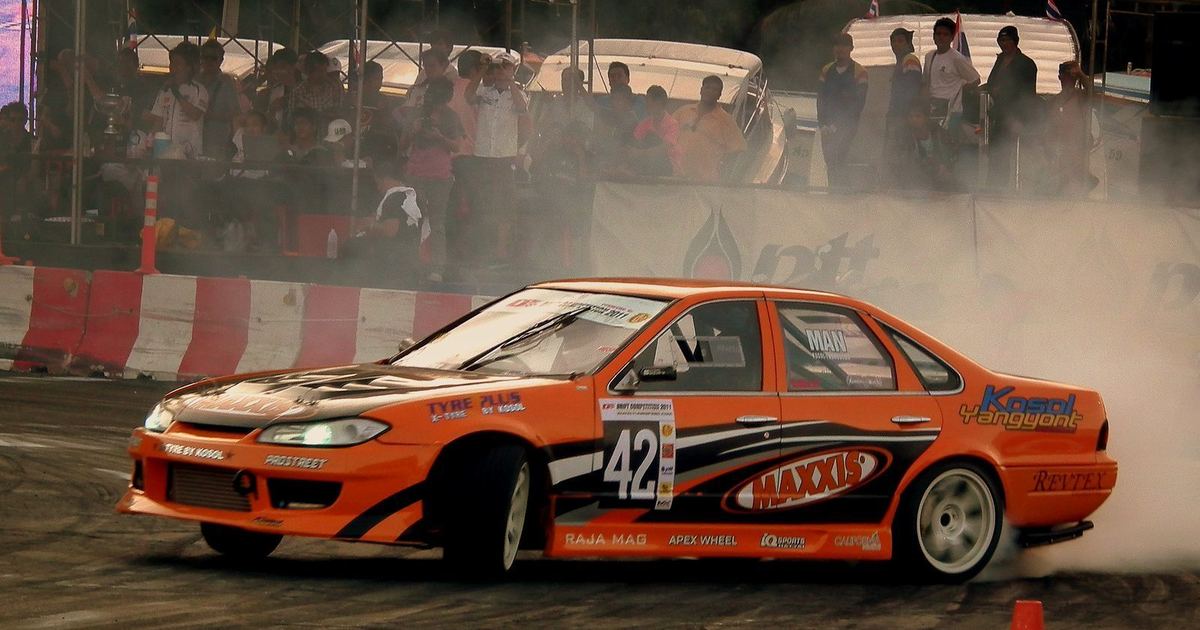
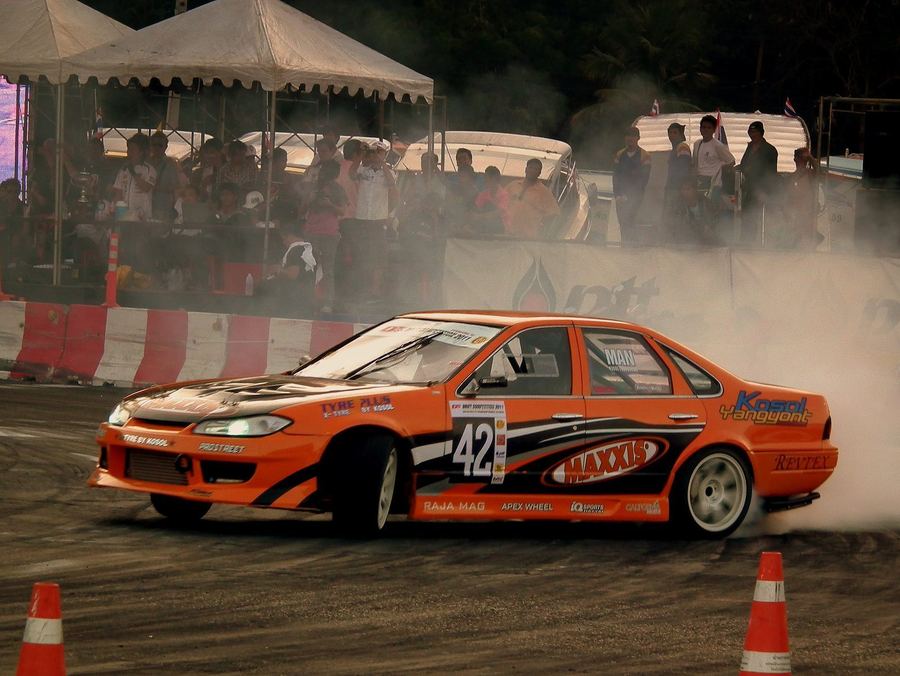
Circuit racing is a contest to complete a distance in the least time. Every technique in it exists to serve that goal, and a driver who is sliding is usually losing time. Drifting inverts this: the slide is the objective, and the run is scored on how well it is performed rather than how quickly it is completed.
That single difference cascades into everything else — how the cars are built, what drivers practise, how events are structured and how winners are decided.
Why drifting is slower — the real physics
A tyre's lateral grip is not constant — it rises with slip angle (the angle between where the tyre is pointed and where it's actually travelling) up to a peak, then falls off once the tyre is properly sliding. For a race-compound tyre, that peak typically sits somewhere around 6–8 degrees of slip angle. A circuit driver is trying to hold the car exactly at that peak, corner after corner, without going past it. A drifting car is deliberately running well beyond it — often 25 degrees or more of slip angle at the rear — which means less forward grip, a longer path through the corner, and a slower car by design.
Drag the slider below to see it directly: the same curve that makes a fast lap fast is the one that makes a drift run slow.
Slip Angle Explorer: Why Sliding Costs Grip
Drag the slider to change the car's slip angle and watch where it lands on a tyre's real lateral-grip curve — the same physics that makes circuit racing fast and drifting slow.
What each discipline actually demands
Circuit racing rewards precision and repeatability at the limit: braking to the same point lap after lap, managing tyre temperature over a stint, and reading racecraft against other cars. The skill is in extracting the maximum without exceeding it, hundreds of times in a row.
Drifting rewards control beyond the limit. The car is permanently unstable and the driver is continuously catching it with steering, throttle and often the handbrake. In tandem it adds a second demand: doing all of that while mirroring another car a metre away, reacting to their inputs rather than a fixed plan. See our breakdown of how a run is actually scored for what judges (and, since 2026, telemetry) are looking for.
How the cars differ
A racing car is built for grip and stability — aerodynamic downforce, stiff suspension, a limited-slip differential that maximises traction, and steering geometry designed for accuracy near the limit.
A drift car is built for the opposite. It runs a locked differential so both rear wheels turn together, extreme steering angle so the front wheels can point far into a slide, a hydraulic handbrake to break traction on demand, and far more power than the rear tyres can use. Cooling is oversized because sustained high revs at low road speed generate heat with little airflow. See our guide to what makes a chassis drift-ready for the specific platforms built this way.
Spec differences at a glance
| Circuit race car | Drift car | |
|---|---|---|
| Differential | Limited-slip or active | Fully locked (spool or welded) |
| Steering angle | Standard road-derived lock | Extreme — often 60°+ via angle kits |
| Suspension | Stiff, low, grip-optimised | Stiff but tuned for controllable slip, often with more front camber |
| Handbrake | Rarely used competitively | Hydraulic, used to snap the rear loose on demand |
| Power target | As much as the chassis and rules allow, matched to grip | Deliberately more than the rear tyres can put down |
| Win condition | Fastest time, unambiguous | Judged line, angle and style (partly automated since 2026) |
Winning: judged versus timed
Circuit racing produces an unambiguous result: whoever crosses the line first, subject to penalties. There is nothing to interpret. Drifting is decided by judges scoring line, angle and style, then by head-to-head tandem battles — though as of 2026, Formula Drift's UDSM system now scores the line and angle components automatically from vehicle telemetry, leaving judges to score style alone.
This makes drifting results more contestable, which is a genuine criticism of judged sport. Series counter it with published criteria, multiple judges (or telemetry, now), and the option to rerun an inseparable battle rather than split it arbitrarily.
Do drivers cross over?
Some do, and the traffic runs both ways. Several professional drifters came from circuit or rally backgrounds, and the discipline's own origin lies with a circuit racer, Kunimitsu Takahashi, whose 1970s sliding style became the template — see our full history of drifting for how that turned into a sport.
The transferable part is car control at and beyond the limit — particularly recovering a car that has stepped out. What does not transfer is the discipline of not sliding: a driver trained to hold maximum angle has to unlearn a great deal to extract a fast lap.
Tyres, cost and consumption
Drifting destroys rear tyres by design. A professional competitor may use several sets in a single event, and tyre supply is a real budget line rather than an afterthought. Circuit racing consumes tyres too, but through gradual degradation rather than deliberate destruction.
Against that, drifting has lower barriers at entry level. A grassroots drift day needs a used rear-wheel-drive car, a helmet and a safe surface. Getting onto a circuit in a competitive racing car generally costs considerably more before the first corner — see our guide to getting started for real first-step costs.
Which is better to watch?
They offer different things. Circuit racing gives you a developing competitive narrative over a race distance — strategy, tyre life, position changes that carry consequences. Drifting gives you concentrated, immediately legible spectacle: every run is short, visually dramatic and self-contained.
Drifting is easier to enjoy without prior knowledge, because a good run looks good. Circuit racing rewards knowing what you are watching, which is why the two tend to attract different first-time audiences even when they share fans.
Frequently asked questions
Is drifting faster than racing?
No. A sliding tyre generates less grip than one at the edge of adhesion, so a drifting car accelerates less and takes a longer path. Drifting is deliberately the slower technique.
What slip angle do drift cars run compared to race cars?
A circuit car is held close to a tyre's peak-grip slip angle, typically around 6–8 degrees for a race-compound tyre. A drift car deliberately runs well past that, often 25 degrees or more at the rear.
Is drifting harder than circuit racing?
They are hard in different ways. Circuit racing demands precision and repeatability at the limit; drifting demands continuous control beyond it, and in tandem, while mirroring another car.
What is the main difference between a drift car and a race car?
A drift car runs a locked differential, extreme steering angle, a hydraulic handbrake and more power than the tyres can use. A race car is built for grip, stability and traction instead.
Do drift cars use a limited-slip differential?
Generally no — competition drift cars use a fully locked differential so both rear wheels rotate together, which keeps the slide predictable.
Can circuit racers drift?
Many can, since car control beyond the limit transfers. The harder adjustment is the opposite direction: a drifter must unlearn holding angle to set a fast lap.
Why do drift cars need so much power?
Power maintains wheelspin and therefore the slide, especially through long corners and transitions. Professional cars often exceed 1,000 horsepower for this reason.
Which is cheaper to get into?
Drifting, at grassroots level. A used rear-wheel-drive car, a helmet and a practice day is a genuinely low barrier compared with competitive circuit racing.
Why does grip fall off past the peak slip angle?
Once a tyre is sliding rather than gripping, the rubber can no longer build up the same lateral force it does just before sliding — the same physics that makes a skidding tyre in a road car take longer to stop.
Is drift judging still subjective?
Partly. As of 2026, Formula Drift's UDSM system auto-scores the line and angle components from telemetry, leaving only the style component to human judges — reducing, though not eliminating, subjectivity.
Do drift cars corner slower than a stock version of the same car?
Through a given corner, yes on lap time — but a drift car is optimised for controllable, sustained slip angle rather than minimum time, which is a different design goal entirely.
Why is drifting easier for new fans to enjoy?
A good drift run is visually self-evident — close cars, big angle, lots of smoke — without needing to understand strategy. Circuit racing's drama is often in the details of tyre life and position battles, which rewards prior knowledge.

Priya covers endurance racing, NASCAR and drifting for CNMOTOS, drawn to disciplines that reward either sustained consistency over 24 hours or outright commitment in a single tandem battle.
View all articles by Priya Shah →

.jpg)