The touge: where it started
Drifting grew out of touge driving — late-night runs on the narrow, switchbacked mountain passes that thread through much of Japan. Drivers on those roads discovered that deliberately breaking rear traction let them carry attitude through tight corners, and that it looked and felt dramatically different from conventional cornering.
None of this was organised or legal. It was a street culture built around cheap, rear-wheel-drive Japanese coupés, and for years it existed entirely outside any sanctioning body. What made it eventually become a sport was that the skill involved turned out to be genuinely difficult and genuinely judgeable.
Kunimitsu Takahashi and the racing origin
The technique itself predates the street scene. Kunimitsu Takahashi, a Japanese motorcycle Grand Prix winner turned car racer, is widely credited as the stylistic origin: in circuit racing during the 1970s he would hit apexes at high entry speed while sliding the car, a method that was effective on period tyres and became his signature.
Takahashi's approach mattered because it demonstrated that a sliding car could be fast and deliberate rather than simply out of control. Younger drivers who watched him took that idea onto the mountain roads, where outright lap time stopped mattering and the slide itself became the point.
Keiichi Tsuchiya, the Drift King
Keiichi Tsuchiya is the individual most responsible for drifting becoming a discipline. He came from the touge scene, moved into professional circuit racing, and — crucially — kept promoting sliding as a skill worth practising in its own right, earning the nickname Dorikin, the Drift King.
In 1987 he appeared in Pluspy, a video that showed him drifting on public roads. It caused him real professional difficulty in Japan, but it also spread the technique far beyond the people who had seen it in person. Tsuchiya later helped organise the first formal competitions, effectively converting a street practice into a judged sport.
D1 Grand Prix and the birth of professional drifting
The D1 Grand Prix, launched in Japan in 2001, was the first serious professional drifting championship. It established most of what the sport still uses: judged runs scored on line, angle and style; solo qualifying followed by head-to-head elimination; and purpose-modified competition cars rather than lightly-tuned road machines.
D1 also proved the format worked as a spectator event. Judging that had previously been informal was codified, and the sport gained the structure it needed to be taken seriously — and to be exported.
How drifting left Japan
Export happened quickly, helped by video, then by the internet, and then by mainstream visibility through car culture and film. Enthusiasts outside Japan had access to exactly the right machinery: rear-wheel-drive coupés from the 1980s and 1990s were cheap, plentiful and mechanically simple enough to modify.
That accessibility is a large part of why drifting spread faster than most motorsport disciplines. A grassroots drift day required a used car, a helmet and a safe surface, rather than a licence, a race series entry and a transporter.
Formula Drift and the American scene
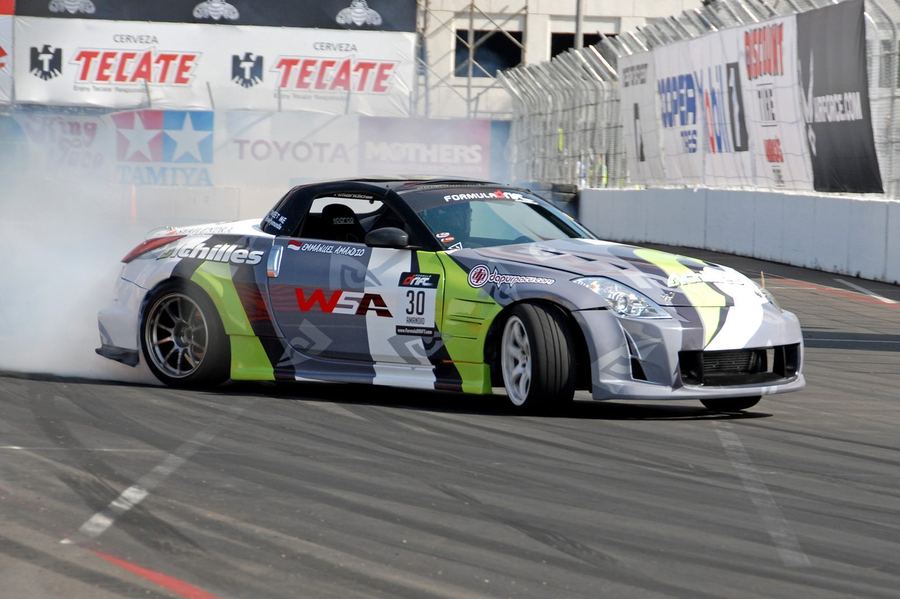
Formula Drift began in the United States in 2004 and became the sport's most commercially visible championship. It brought bigger power outputs, professional teams, manufacturer involvement and television production, and pushed competition machinery well beyond what the Japanese scene had used.
The American series also accelerated an arms race. Where early competition cars ran a few hundred horsepower, professional Formula Drift entries now routinely exceed 1,000, with purpose-built chassis, extreme steering geometry and aerodynamics borrowed from circuit racing.
Europe, Ireland and the modern international scene
Europe developed its own strong scene, with Drift Masters becoming the leading continental championship and Ireland in particular producing a disproportionate number of top-level drivers. British, Polish, Latvian and Lithuanian competitors are now regular contenders at the highest level.
The result is a genuinely international sport with several parallel professional championships rather than one global pyramid. A driver can build a career in Japan, the United States or Europe, and the leading names increasingly compete across more than one.
What changed as the sport professionalised
Three things changed most. Power rose enormously. Judging became formalised and published rather than informal. And the cars stopped being modified road machines: a modern professional drift car is a purpose-built competition vehicle with a tube chassis, sequential gearbox and steering geometry no road car would tolerate.
What has not changed is the fundamental proposition. The sport still rewards a driver's ability to hold a car deliberately beyond the limit of rear grip, exactly as it did on the mountain roads — it is simply now measured, televised and contested by professionals.
Frequently asked questions
Where did drifting originate?
On Japanese mountain passes known as touge, where drivers on narrow switchbacked roads began deliberately sliding rear-wheel-drive coupés through corners. It started as an unsanctioned street practice.
Who is the Drift King?
Keiichi Tsuchiya, nicknamed Dorikin. He came from the touge scene, raced professionally, and did more than anyone to establish drifting as a discipline worth competing in.
Who invented drifting?
No single person, but Kunimitsu Takahashi is usually credited with the style's racing origin in the 1970s, sliding through corners at high entry speed as a deliberate circuit technique.
What was the first professional drifting championship?
The D1 Grand Prix, launched in Japan in 2001. It codified judged scoring, solo qualifying and head-to-head elimination — the structure the sport still uses.
When did drifting reach America?
Formula Drift launched in 2004 and became the leading American championship, bringing far higher power outputs, professional teams and television coverage.
Why were Japanese cars used for drifting?
They were rear-wheel drive, mechanically simple, widely available and cheap. That combination made experimenting affordable, which is a large part of why the sport spread so fast.
How much have drift cars changed?
Enormously. Early competition cars were modified road machines with a few hundred horsepower; professional entries now regularly exceed 1,000 horsepower on purpose-built chassis.

Priya covers endurance racing, NASCAR and drifting for CNMOTOS, drawn to disciplines that reward either sustained consistency over 24 hours or outright commitment in a single tandem battle.
View all articles by Priya Shah →